What if intelligence requires maps to navigate complex information?

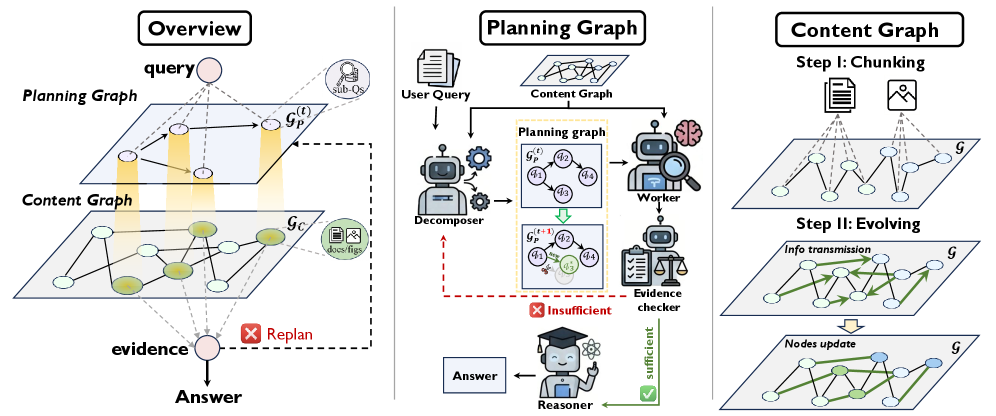
When you read a research paper with charts, tables, and flowing text, your mind naturally connects related pieces across pages, building an internal map of how ideas link together. Traditional AI systems struggle with this because they chop documents into isolated fragments, losing the web of connections that gives meaning to individual pieces.
Researchers created a system that thinks about documents the way your brain does, using two complementary maps. The first preserves the natural structure of information, keeping figures connected to their captions and related text passages linked together. The second tracks the reasoning process itself, breaking complex questions into smaller parts while maintaining awareness of what has been discovered and what remains unknown.
The breakthrough lies in recognizing that understanding requires both spatial awareness and strategic thinking. Just as you might flip back to an earlier chart while reading a conclusion, or hold multiple partial answers in mind while searching for missing pieces, this AI maintains persistent memory of both document structure and reasoning progress.
Most intriguingly, the system outperformed much larger AI models by thinking more systematically rather than simply processing more data. This suggests that intelligence emerges not just from computational power, but from organizing information and reasoning in ways that mirror biological cognition. The architecture reveals how meaning depends on relationships between ideas, not just the ideas themselves.
follow 'me AI' for daily AI/LLM news